
Identify a Vermillion Property Owner
Finding who owns a property in Vermillion County works best with two records rather than one search result. The tax card supplies the owner lead. The recorder's indexed deed shows the recorded transfer. WebGIS helps with vague or rural addresses. Keep the parcel number and legal description beside the name, because similar labels can point to two different people or tracts.
- Search the address in the county tax property-information system. If it misses, try the surname or map the parcel in WebGIS.
- Open the parcel card and record the Deeded Owner, parcel key, legal description, property address, and owner-history date.
- Search that owner in Doxpop and identify the newest deed tied to the same parcel or legal description.
- If a company is named, use Indiana's business search. If a trust or life estate appears, read the deed wording.
The result names the public owner of record. It does not prove who occupies the property or whether an unrecorded claim exists.
Vermillion's Deeded Owner Field
The tax card labels its ownership field Deeded Owner. Some cards add an owner history with dates. That beats a loose address result. The card also bundles the parcel, acres, legal description, and tax context in one place. One rural sample even uses “LAND LOCKED” as its address, which shows why the parcel key can matter more than a street line.
The legacy tax search takes parcel, name, tax year, or address. Its warning covers parcels split or combined in the last two years, which may need a last-name search or a call to the Treasurer. Remember that quirk. An owner search that returns an old tract or nothing often traces back to it.
Where Vermillion Ownership Is Shown
Each system answers a narrower version of “who owns this property.” Match the source to the task, then cross-check the answer against the parcel identity.
| Source | Owner Info It Gives | Access |
|---|---|---|
| Auditor tax card | Deeded Owner, address, parcel key, legal text | Current roll lead; a new transfer may lag |
| Recorder and Doxpop | Grantee, document type, date, book or instrument | Newest recorded deed is the key confirmation |
| WebGIS | Mapped parcel and available attributes | Current map context, not title proof |
| Indiana business search | Entity record and registered agent | Current state filing, not the deed itself |
A tax bill often lists a mailing address that differs from the situs address, the physical spot where the parcel sits. Farms, inherited land, and entity-owned property frequently show this split. A mailing address alone never proves who occupies the property, so treat it only as where the tax roll sends its notices.
Confirm Who Owns Through Doxpop
The Vermillion County Recorder sends searchers to Doxpop for recorded documents. Deeds reach back to January 2, 1969. Miscellaneous instruments start March 1, 1972, and mortgages July 12, 1988. When you search, try spelling variants, initials, and punctuation, plus trust or entity forms of the deeded owner's name, then match the legal description or parcel reference to the right deed.
An index entry only points to the instrument. The grantee receives the interest. The grantor gives it up. A deed recorded last week can still be newer than the current tax roll, so pull the actual instrument and get qualified title help whenever ownership matters to a transaction. The county-linked recorded-document search displays the results.
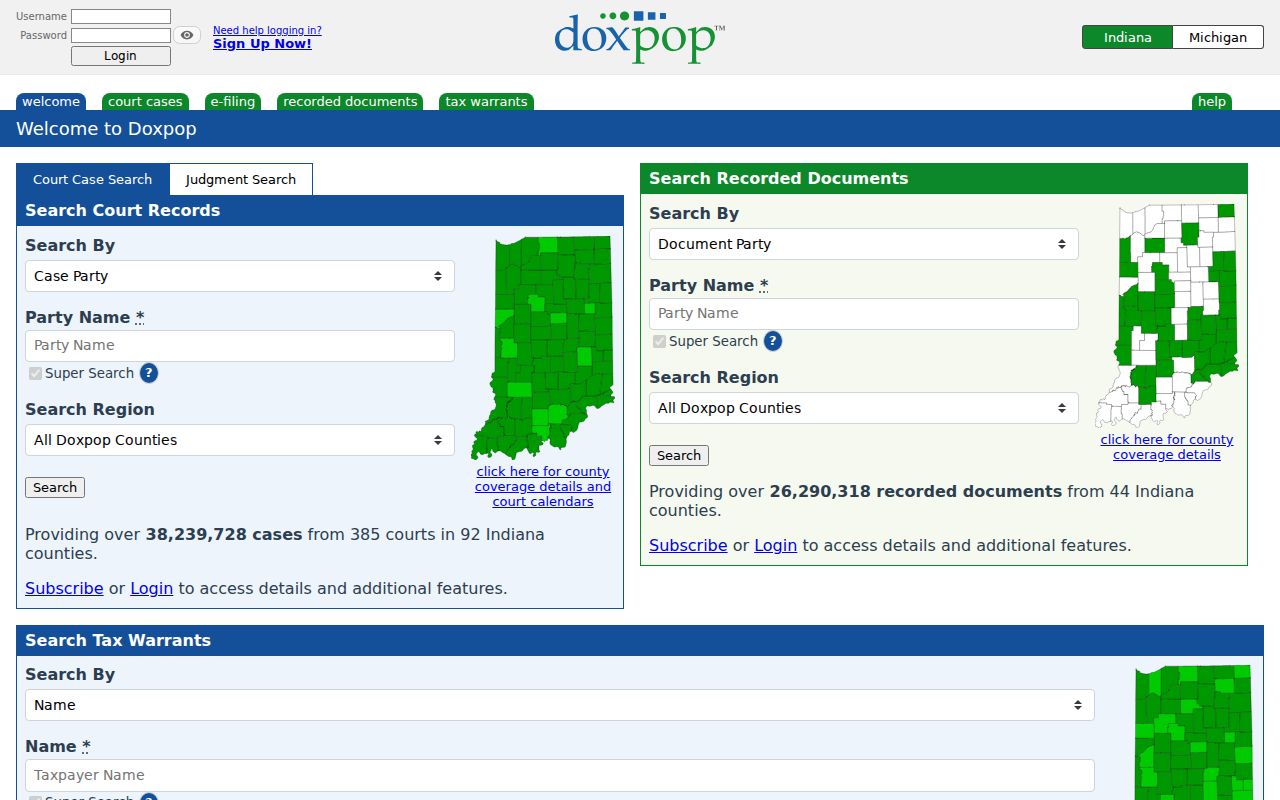
The party-first layout makes exact name variants and the parcel's legal description essential. Only those details confirm you have the right deed among similar owner names.
Vermillion Trusts and Entity Owners
A company name on the tax roll is still an owner of record. Run it through the Indiana Secretary of State business service to find the entity record and registered agent. The agent is the official contact. That role does not make the agent the landowner, so return to the deed for the actual interest held.
Trusts, estates, and life estates deserve the same care. One county card example uses "Life Estate Then To," which signals both present and future interests. A short search result cannot explain that structure. The recorded deed, and probate orders where they apply, show the full legal picture.
- Owner of record
- The party named as owner in the public roll or recorded chain.
- Grantee
- The person or entity receiving the interest in a deed.
- Title
- The legal ownership interest, which is broader than a name displayed online.
- Situs address
- The parcel's location, distinct from the tax mailing address.
Watch a Vermillion Owner Name
Doxpop Property Watch tracks a name. It also tracks a set of parcel descriptions against new Vermillion County recordings. When a fresh deed or mortgage is filed, the service sends word. Before enrolling, the recorder's Fraud Watch instructions recommend testing spelling variants. Indexed owner names are sometimes misspelled. Watching future filings this way protects your own name and land. It does not prove current title, though. So treat alerts as a heads-up rather than the final word on who owns the property. The official Fraud Watch page spells out the enrollment details.
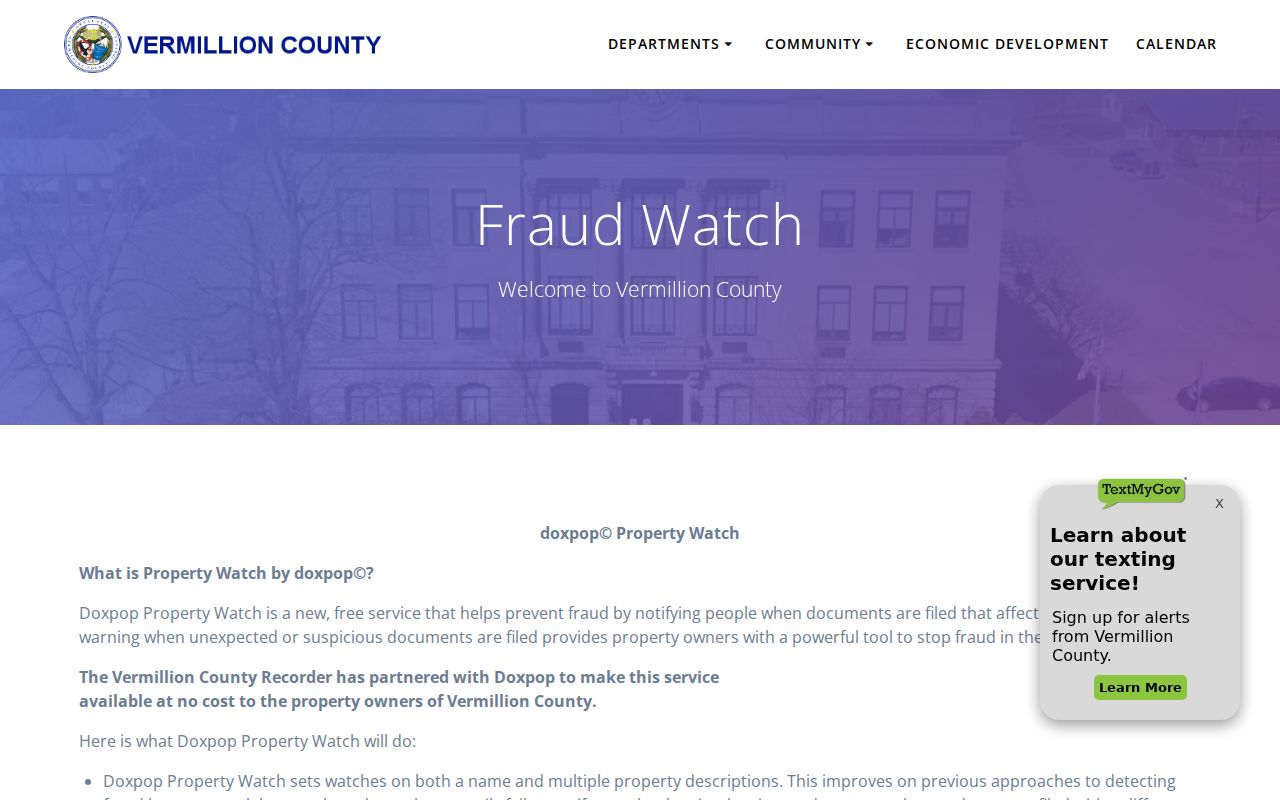
An alert only tells you that something new hit the property records. The Recorder's instrument itself shows what was actually filed.
Limits of a Vermillion Owner Lookup
An assessor name is not a title opinion. Neither is a GIS label, a tax bill, or a deed-index row. Keep that distinction in mind when a Vermillion County lookup settles an ownership question. Public property records also cannot establish who physically lives at a site. One wrinkle exists here. An address record may list a substitute address for a participant in Indiana's Address Confidentiality Program. That confidential data stays withheld.
Lawful use. Use Vermillion County owner information for purchase diligence, estate work, boundary research, and land questions. Never use it to stalk, threaten, or harass a person.
If a field in the property records looks wrong, ask the custodian directly. Indiana APRA requires the office to provide an existing record described with reasonable detail. So name the parcel, the record type, and the date range. Include the document number when you have it. The office does not have to build a custom title report for you.
Offline Vermillion Owner Confirmation
The counter still matters. The Recorder's public counter sits at 255 S Main Street, Room 202, in Newport. It is open Monday through Friday from 8:00 a.m. to 4:00 p.m. A phone line is available at 765-492-5380. Come prepared. Bring the exact parcel key. Bring every plausible spelling of the owner's name. Also bring the instrument type and a rough date range. The Recorder scans, indexes, and microfilms accepted instruments and sells official copies over the counter.
Hard-to-pin-down records call for the county's public-record request form. A requester picks the Assessor, Auditor, Recorder, Surveyor, Treasurer, or another office. Indiana APRA asks that a record be described with reasonable particularity. A deed number or a parcel card tied to a named key works far better. It beats asking the county to figure out who owns a tract.
Older deeds live in the Recorder's books. The Indiana State Library serves as a second stop. The local library holds old directories, maps, microfilm, and newspapers too. Those clues help bridge name and address changes over the years. Still, the recorded deed sequence is what proves ownership.
Review a Vermillion Owner Result
Any owner name pulled from Vermillion County property records deserves a second look. Check it before you rely on it. Test the finding against the full parcel, not just the name field. The property address, mailing address, parcel number, acreage, legal description, and owner-history date should all agree with one another. The tax district should match too. One conflict is a stop sign. Resolve it through WebGIS, the tax card, or the Recorder before going further. Remember that postal city names and tax districts do not always follow incorporated boundaries.
Dates need careful labels. A tax year is not a recording date. A document date is not necessarily the day the Recorder accepted the deed. An owner-history date may mark a transfer without revealing its terms. Keep the source date beside each fact. That prevents an older web result from overwriting a newer deed.
Separate the owner of record from everyone else attached to the parcel. A registered agent accepts papers for a company. A trustee acts for a trust. A life tenant holds a present interest. A remainderman holds a future one, and a mailing contact may not live on the property at all. Those distinctions shape any sound answer to who owns the property in Vermillion County.
A parcel-level mismatch can also signal a recent split or combination. The county tax search suggests trying the last name when the address route fails. Contacting the Treasurer is another option for such parcels. Save both the old and new keys if they appear. Then use the legal description to confirm which resulting tract the deed actually covered. That safeguard keeps a familiar owner name from landing on the wrong piece of land.
Note: Record your search date, since later county updates can change the displayed owner or parcel relationship.