
Vermillion County Deed Record Types
Deeds sit beside mortgages, easements, liens, subdivision plats, leases, powers of attorney, bonds, and releases in the Recorder's permanent collection. Identify the instrument type first. Not every filing in the deed records actually moves title.
| Deed Type | What It Does | Common Use |
|---|---|---|
| Warranty deed | Conveys the stated interest with deed covenants | An ordinary sale |
| Quitclaim deed | Conveys whatever interest the grantor has | Interest cleanup or related-party transfer |
| Corrective deed | Corrects an earlier recorded instrument | Name or description correction |
| Trustee or executor deed | Conveys through a fiduciary role | Trust or estate administration |
| Sheriff or tax deed | Reflects a statutory sale process | Distressed-property transfer |
A deed conveys an interest, depending on its wording. A mortgage only secures a debt, a release clears an earlier filing, and an easement grants a limited use. Each instrument can shape the parcel's paper trail. None of them makes the indexed party the fee owner.
Vermillion Grantor-Grantee Deed Trail
Doxpop starts the search with a party name. To build a chain backward, take the current deeded owner, find the deed that placed them in title, note the earlier grantor, and repeat. Match the legal description at every step. The same person can appear in several instruments or on different parcels entirely.
- Find the current owner's acquiring deed with that owner as grantee.
- Read the grantor, document type, recording date, and land description.
- Search that grantor as an earlier grantee and verify the same tract.
- Record each book, page, or instrument reference; move to deed books when the web series ends.
- Grantor
- The party conveying the stated interest.
- Grantee
- The party receiving that interest.
- Chain of title
- The linked sequence of instruments for one tract.
- Book/page or instrument number
- The Recorder's reference used to retrieve a filing.
Vermillion Deed Index Cutoffs
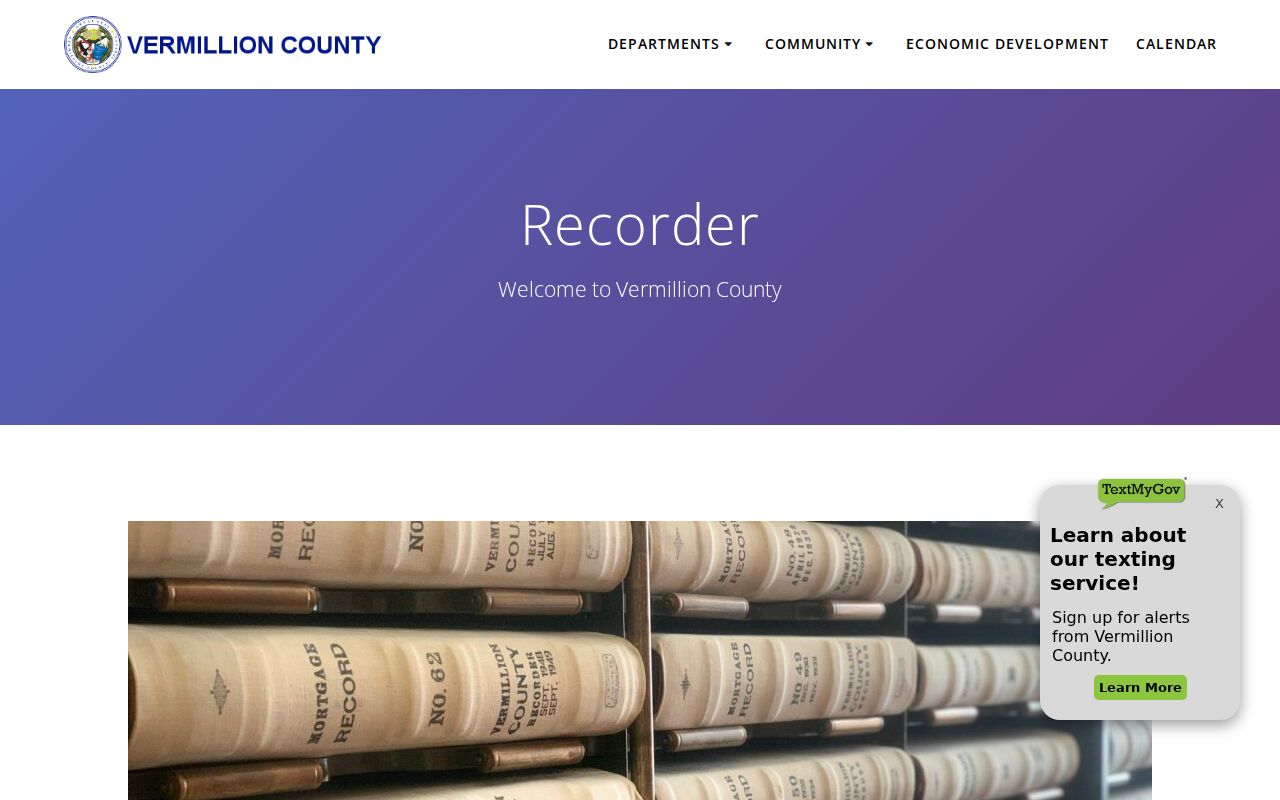
Online coverage runs at three separate depths. Deeds reach back to January 2, 1969 at Book 110. Miscellaneous instruments begin March 1, 1972 at Book 48. Mortgages start July 12, 1988 at Book 126. These cutoffs are not interchangeable. Keep both the date and book boundary for whichever series you are working in. Older deeds take a courthouse or archive route. The Recorder can pull a known book and page on request. State Library guides, map holdings, microfilm, and the Clinton Public Library collection supply the names and land clues. Those clues point the way. Note: The Recorder page states the county's online coverage and office access.
When an index entry or a vendor image is not enough, request the official copy. The Recorder is the source for certified deed records.
Vermillion Recorder Fees and Copies
Recording a deed or most other instruments costs $25 under the county fee schedule. Mortgages, including corrective and supplemental indentures, run $55. Recorded copies at 11 by 17 inches or smaller cost $1 per page. Certification adds $5 on top of that per-page charge. A blanket document carries an extra $7 for each legal description or parcel beyond the first. Recording fees and copy prices are different things. Someone who already owns the deed of interest usually needs the copy price alone. Scam letters once offered a deed for $99. The county warned residents because a plain office copy costs far less.
The 1844 Vermillion Record Story
The Indiana State Library records a courthouse fire in 1844 with no records lost. That corrects a stubborn assumption. A missing online image does not mean the deed burned. Check historical gaps by series. The county guide points to original custodians and WPA indexes. State Library map holdings span owner-labeled maps, atlases, and modern plat books. A name on the 1872 owner map or in the 1968 farm atlas is a lead. It points toward the deed book. Treat it as a clue, not proof of ownership.
Monitor Vermillion Deed Filings
Doxpop Property Watch tracks names and property descriptions for newly indexed deeds or mortgages. The Recorder recommends spelling variants. The index may not normalize a name the way you expect. An alert is a warning light, not a legal block on filing. Any notice should be checked against the official recorded instrument. Compare party roles, the legal description, dates, and prior references. Contact the Recorder if a filing looks unfamiliar.
Request a Vermillion County Deed
Start in Doxpop with the party name and recording reference. If the image is gated, or the deed predates online coverage, write the Vermillion County Recorder. The address is 255 S Main St., Room 202, Newport, PO Box 145, or call 765-492-5380. Provide the names, an approximate date, the instrument type, and a book/page or document number. For a deeper ownership chain, the former-owner record route walks backward across deeds. State Library and Clinton Public Library collections can help. That is useful when all you hold is an old map, a directory address, a township, or a family name.
Recorded, not guaranteed. Vermillion County deed records show filed instruments. They do not promise clear title, resolve unrecorded interests, or replace professional title work.
Descriptions Anchor Vermillion Deeds
Party names open most deed searches. The legal description proves whether two results concern the same land. A section, township, and range can separate similar names. So can a subdivision lot with its listed exceptions. The full instrument image carries details the index row leaves out, such as a parcel reference, consideration, return-to address, preparer, and signatures tied to earlier filings.
One Vermillion County tax-card sample describes part of a lot in 2nd Spring Park Subdivision with several exceptions. Carry that wording exactly into the deed trail. Do not shorten an exception. Never turn a half-lot into the whole lot. If a plat is cited, pull the recorded plat and check it against the current parcel map.
Mortgages, releases, liens, easements, and covenants form a parallel chain. Follow assignments back to the original instrument. A paid tax bill does not release a recorded mortgage. A map line does not grant an easement, and the document text controls the record's stated effect.
Vermillion Deeds and Court Files
Deed chains jump for many reasons. An estate, foreclosure, sheriff sale, tax sale, quiet-title judgment, or partition may sit between ordinary Vermillion County deeds. Search MyCase for the party. Use the Clerk's files when records are offline. Then return to the Recorder for any deed or notice recorded from that case. MyCase is an index, not a certified file. Document depth varies, so keep docket and deed dates labeled separately, and remember that Vermillion Circuit Court is the county's only court of record under the local rule.
Vermillion Recorded Copy Costs
The fee schedule splits recording costs from copy costs. Mortgages cost fifty-five dollars. That covers re-recorded, corrective, and supplemental indentures. Deeds and other instruments, including releases, large maps, surveys, and county UCC filings, run twenty-five dollars. A mechanic's lien with one mail-out costs twenty-five dollars, and added mail-outs are two dollars each. An oversize page beyond eight and one-half by fourteen inches adds five dollars.
Researchers care most about the copy charge. A recorded copy up to 11 by 17 inches costs one dollar per page. Certification costs five dollars plus one dollar per page. The county also warns about solicitation letters offering deed copies for ninety-nine dollars. That is not the Recorder's normal copy price. Contact the office directly before ordering. Supply the party names, document date, book and page, or instrument number.
A certified copy is an authenticated reproduction from the custodian. Certification does not make it a title opinion. Doxpop likewise warns that its database is not the official record. The office copy governs what was recorded, while a title professional weighs the broader chain, exceptions, and interests that one deed cannot resolve.
Survey Filings in Vermillion Deed Records
The published survey index gives land-record research concrete vocabulary. A sample entry shows document 2025000176 IN and record type SURV-SURVEYS. It carries a February 2025 recording date. The document date is January 2025. The entry also lists zero-dollar consideration, landowner and surveyor roles, and a full parcel number. It includes a section, township, range, and acreage description. Return-to information, a POSTED status, and a twenty-five-dollar fee round out the row.
Those fields separate a survey filing from a purchase deed. Zero consideration does not prove nothing happened. Some instruments simply are not sales. A survey can clarify how land was measured or described. Yet its presence in the Recorder's system does not make every WebGIS line a surveyed boundary. When a line's location matters, retrieve the survey image. Pull any cited plat and the deed description.
The Surveyor keeps a corner record book. That office also handles regulated drains, watersheds, property-line maps, and GIS support. The Auditor prepares current ownership and valuation plats by township. The Recorder preserves the recorded survey or plat instrument. No single map viewer holds every legal and physical fact. Routing a question among those custodians produces the stronger answer.