
Vermillion County Owner of Record
The tax card's exact label is Deeded Owner. It sits beside the property address, parcel key, acres, legal description, tax data, and owner-history dates. That bundle is what makes the card useful. The name stays tied to one tract. It is not a title opinion, though, and it names no occupant.
| Deeded Owner | The person, trust, estate, or entity carried on the tax card |
|---|---|
| Property Address | The parcel's situs, which may also be a rural descriptor |
| Parcel Key | The exact cross-reference for tax, GIS, and deed work |
| Legal Description | Subdivision, lot, acreage, or section clues for matching land |
| Owner History Date | A transfer clue that should be checked against the deed |
The mailing address is where notices go. The situs address is where the land sits. Use the public mailing line for lawful contact, but do not treat it as proof of where the owner lives.
How Current Vermillion Owner Records Are
Vermillion County publishes no promised refresh interval. Treat the tax roll as a lead. It is not proof that yesterday's deed already shows. A deed moves through recording, transfer review, Auditor work, and assessment systems. The owner-history date on a card helps, but the web display may not update at closing.
The county portal adds a warning of its own. Parcels split or combined in the last two years may not work well by address. Try a last-name search or call the Treasurer. When a result looks stale, keep the old and new parcel clues, then check the Recorder's most recent deed.
Freshest evidence. A newly recorded deed can outrun the tax roll. Match its legal description before accepting the grantee as the current owner.
Vermillion Address and Parcel Checks
Begin with the street and city. Save the parcel key once it appears. Official keys begin with 83-. The county publishes no decoder for every hyphen group, so copy the key whole. A landlocked parcel may carry no standard street address yet still show acres, section, legal description, owner history, and tax calculations.
Tax districts and postal cities need the same care. A Clinton, Cayuga, or Dana mailing label does not place the tract inside that municipality. WebGIS geometry and incorporated-area layers settle the location, while the legal description identifies the land conveyed.
Confirm the Current Vermillion Owner
Use the owner field as the lead. Confirm with the newest recorded deed. The Vermillion County Recorder links to Doxpop and reports online deeds from January 2, 1969. Search name variants, then match the parcel or legal description so a similar name is not mistaken for the subject land.
- Search the county tax system by property address, owner surname, or exact parcel key.
- Read the Deeded Owner and copy the legal description and owner-history date.
- Search Doxpop for the newest deed naming that owner and tract.
- Read the vesting terms. Check an entity name in Indiana business records, but do not confuse its registered agent with the owner.
- Owner of record
- The party the public land and tax records presently name.
- Assessment roll
- The county record used to carry parcel ownership and value for tax administration.
- Vesting
- The deed language that states how an interest is held.
- Recording lag
- The gap between a deed's recording and its appearance in another county system.
Vermillion Life Estates and Trusts
One county sample carries the phrase Life Estate Then To. More than one interest may exist now. One party holds a life estate. Another holds a future remainder. A short owner line can flatten that structure. So read the latest deed and turn to probate records when an estate or death transfer touched the title.
An LLC or corporation owner appears in the Indiana business search. It confirms the entity record and registered agent. A named trust works differently. The public deed may identify a trustee, but private trust terms may not be recorded. Keep the legal owner distinct from a contact person or beneficiary.
Current Owners Can Watch Recordings
The Recorder's Fraud Watch instructions point owners to Doxpop Property Watch. That service monitors a name and property description for later deeds or mortgages. The county advises spelling variants. Indexes can misspell names. The service sends alerts, not a title guarantee. The Fraud Watch page also spells out the enrollment steps and the name-watch purpose.
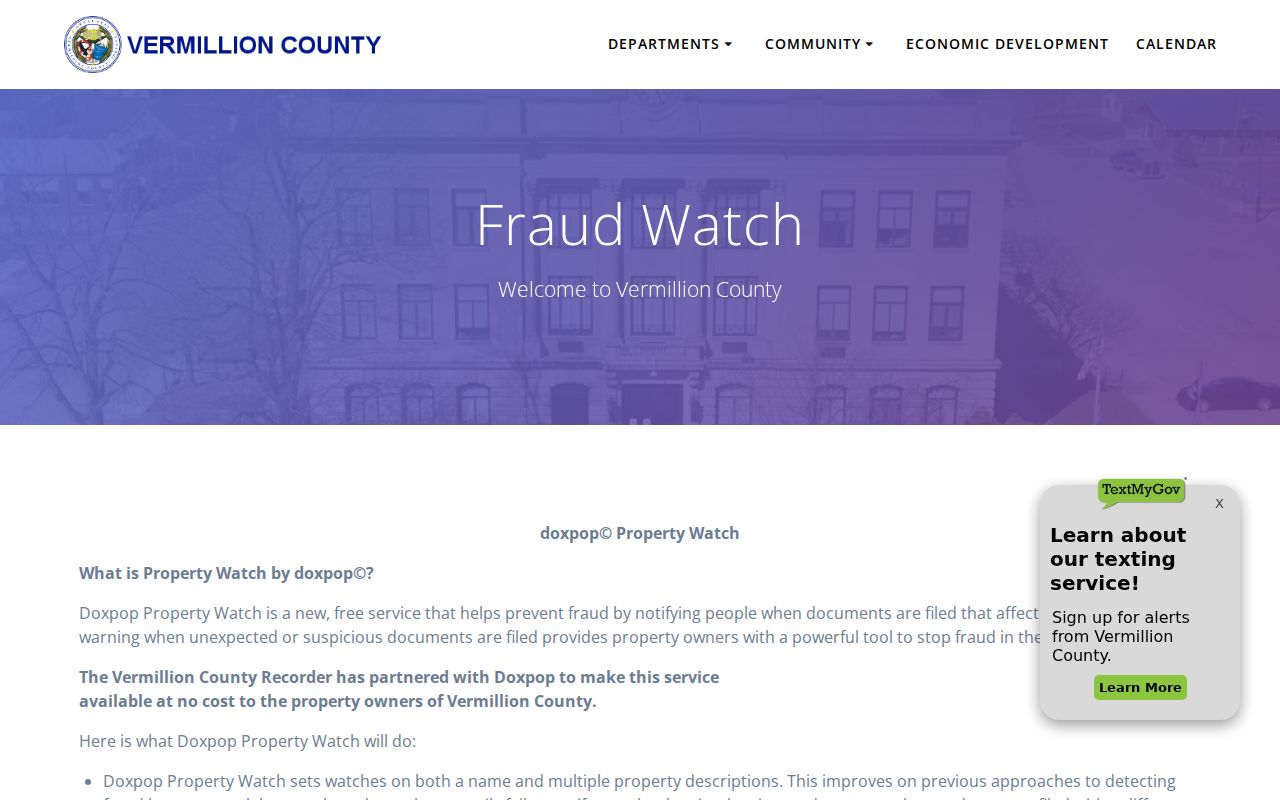
An alert only prompts a closer look. The recorded instrument still controls what was placed of record.
Contact a Vermillion Property Owner
A public tax mailing address is the practical route for a boundary question, purchase inquiry, easement matter, or estate issue. Name the parcel in your note. State your reason plainly. Do not infer occupancy from the mailing line. Indiana's Address Confidentiality Program may substitute an address for a qualifying survivor, and other protected data stays out of public view.
Lawful use. Public owner records support legitimate property contact. They must never be used to stalk, intimidate, target, or harass another person.
For an official check unavailable online, visit the Recorder counter in Room 202 at 255 S Main Street in Newport, call 765-492-5380, or submit the county's APRA request form. Ask for an existing record with a parcel key, document number, and date range.
What Current Owner Does Not Mean
The name on a Vermillion County tax card is the owner of record for billing purposes. That is not the whole story. Mortgages, liens, and easements do not appear there. Probate claims and unrecorded interests stay invisible too. The county's WebGIS may repeat that owner attribute, but a map layer is not independent title proof. A tax bill proves an account and a charge, not ownership free of other claims.
Recent sales need extra care. The card's owner-history date is only a transfer clue. A deed's document date and its recording date answer different questions in Vermillion County property records. Check the grantee, the deed type, and the land description. A zero-consideration survey is not a sale. Nominal consideration may not reflect market price.
A purchase dispute or competing interest calls for a professional title search, while a simple notice or boundary inquiry may need only the recorded mailing address on the deed.
Label Current Owner Evidence
Keep a short audit trail whenever current ownership matters. Save the tax year viewed. Record the parcel key, the Deeded Owner spelling, the owner-history date, the latest deed recording date, and the instrument reference. Add the legal-description match. Recheck it after any county update. The trail separates what the tax roll states from what the deed confirms.
Never merge conflicting names. A middle initial, trust suffix, or estate label can point to a different indexed party, so search each variant and keep the exact recorded spelling. When the deed and the Vermillion County tax card still disagree, ask the Recorder or Auditor about the existing record instead of guessing which system is late.