
Fields in Vermillion Property Tax Records
The county card combines identification, assessment, deduction, and charge data in one place. Keeping those groups separate prevents a gross assessment, taxable assessment, installment, and market value-in-use from being treated as the same number. The identification block labels the parcel, while deduction entries adjust what the tax bill finally charges.
| Field | What It Shows | Where |
|---|---|---|
| Gross assessment | Land and improvement values before deductions | Assessor and tax card |
| Deductions | Homestead and other approved reductions | Auditor and tax card |
| Taxable assessment | The amount left for the tax calculation | Tax card |
| Charges and status | Spring, fall, balance, payments, and warning flags | Treasurer pages |
| Tax district | The local taxing unit tied to the parcel | Auditor and Treasurer records |
Indiana assesses at market value-in-use on a 100 percent ratio, and ratio studies test whether the county lands between 90 and 110 percent. That is mass appraisal, though. It is not a private appraisal of one property. Deductions, caps, rates, and district lines can all shift the tax due while the assessed value itself barely moves.
Look Up a Vermillion Tax Bill
The Auditor's legacy lookup takes a property or parcel number, owner name, tax year, and property address. Enter the city and avoid overfilling the form. LowTaxInfo serves as the separate county-linked route for property lookup and payment. Treasurer legacy pages add warning and judgment lists.
- Search the county tax list by parcel, owner surname, or a short address with city.
- Open the matching card and confirm the parcel, tax year, district, legal description, and deeded owner.
- Read current charges, balance, spring and fall installments, total payments, and warning flags.
- Check deductions and taxable assessment, then use Treasurer sale or judgment records when delinquency is at issue.
- Assessed value
- The Assessor's value under Indiana's market-value-in-use system.
- Taxable assessment
- The assessed amount left after applicable deductions.
- Homestead deduction
- An approved reduction reflected in the tax calculation.
- Tax lien
- A claim arising from unpaid taxes, distinct from an unpaid installment label alone.
Vermillion Tax Search Warnings
One caution comes straight from the county search itself. A parcel split or combined within the last two years may not surface under its old key, so try the owner's last name or call the Treasurer. That quirk is portal-specific. A no-result therefore never proves land or debt vanished. Separately, a Treasurer card may carry an "Under Appeal" flag, which is useful context but leaves the rest of the card intact. The parcel, acreage, legal description, charges, assessment, and owner history still stand. Just read the flag together with its year.
Vermillion Deductions and Transfers
The Auditor wears many hats. The office handles the tax duplicate, current plats, sales disclosures, transfers, and most deduction programs. Available forms cover homestead, over-65, blind or disabled, disabled-veteran and surviving-spouse, heritage-barn, and other categories. Note: the mortgage exemption no longer applies to new or current filings for 2023 pay 2024. A sales disclosure normally travels with a deed. The Assessor approves it. The Auditor processes it. The deed then moves on to the Recorder. The county lists a $20 sales-disclosure fee effective July 1, 2021. There is no charge for exempt disclosures, and a $10 transfer fee applies per parcel. Those are processing fees, not property tax installments.
Vermillion Delinquency Record Clues
The Treasurer warning list lets you search by parcel, name, tax year, and property address. A separate judgments list works from parcel number, tax year, certified amount, and owner. Tax abatements filter by year and entity. They cover all county, Clinton City, Cayuga, and Dana. Fields include district, parcel, owner, abatement, and tax difference. The 2025 tax-sale advertisement listed 189 properties with redemption percentages and dated expirations. An advertisement is just one stage of a legal process. It does not prove a tax deed issued. Confirm any ownership change through later Treasurer, Recorder, and court records first.
Vermillion Reassessment Through 2030
Indiana's cyclical reassessment runs from 2026 through 2030. About 25 percent of parcels are physically inspected each year. The 2026 group starts in May. The full four-year cycle wraps up by January 1, 2030. Annual trending continues alongside the inspections. The DLGF reassessment page describes the statewide cycle that applies in Vermillion County.
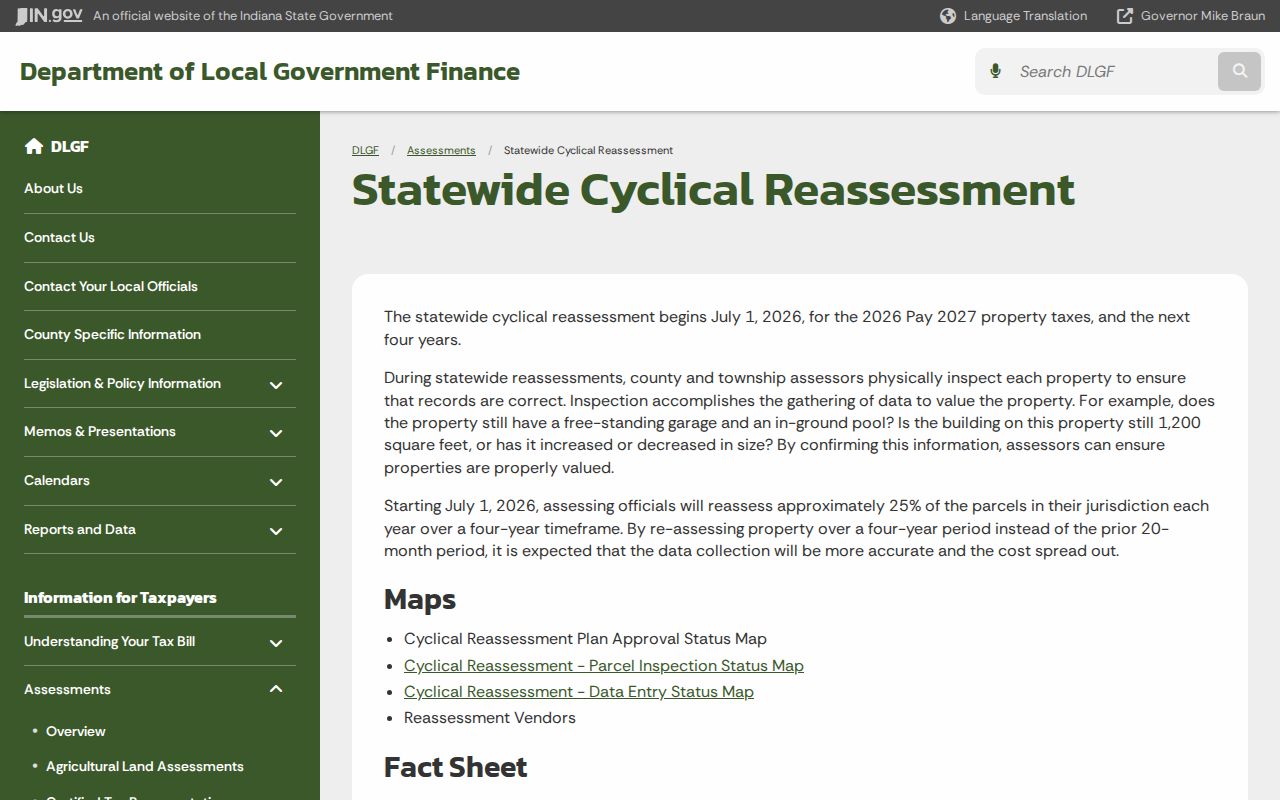
That cycle explains why inspection timing and annual tax labels deserve their own sentences. Blending figures from different years invites error.
Appeal a Vermillion County Assessment
Vermillion County's appeal guidance points owners to Form 130. The case then goes to the Property Tax Assessment Board of Appeals, known as PTABOA. The filing deadline is June 15, or 45 days after the triggering notice. Evidence wins these cases. Comparable sales, photos, and repair estimates all carry weight. So do income data where apt and specific property errors. A bare complaint that taxes feel high does not. Remember, the appeal targets the assessment. It does not reach the tax rate or a private estimate of sale price. From PTABOA, a case can move to the Indiana Board of Tax Review. File with the required parcel and notice details. Keep proof of filing, and answer hearing notices on time.
Appeal window. File Form 130 by June 15 or within 45 days of the relevant notice, as the county guidance directs. Verify the deadline on the current notice.
Read Vermillion Tax Years Carefully
The county's sample labels both an assessment year and the year the tax is payable. That distinction matters whenever you compare values, charges, or owner history. A deed recorded in one period may not show up on the next tax-roll view right away. No county source promises a fixed transfer-to-roll delay. Keep the last-updated date, tax year, payable year, notice date, and payment status attached to every figure you copy. An old screen never proves today's balance. The Treasurer confirms payments, delinquency, sale status, and redemption questions. The Recorder confirms any later deed or release. Tax district codes offer clues, not municipal boundary proof. Clinton City, Cayuga, Dana, Newport, and township districts help sort result rows. Compare the parcel in WebGIS before treating a postal city or district label as a legal incorporated boundary.
Vermillion Tax Access Beyond the Web
Online access only goes so far. A portal may fail. Or an older item never made it online. When that happens, the Vermillion County Assessor, Auditor, and Treasurer can still help in person. Ask for a defined parcel card, tax duplicate entry, notice, deduction form, current plat, charge record, or judgment record. Indiana APRA supports inspection of existing public records described with reasonable particularity. It never requires the county to create a custom analysis for a requester.
Paying is separate from research access. The Treasurer offers Forte online payment plus a phone-payment route using county code 2479. Vendor fees may apply. Confirm the current amount with the Treasurer before paying. Posted figures can lag behind new charges.
Vermillion Tax Card Calculations
A residential tax card builds its math in layers. Homestead land and homestead improvements sit on separate lines. From there the card stacks gross assessment, cap class, deductions or exemptions, taxable assessment, and gross tax. Related amounts round out the stack. Current charges get their own year, balance, spring installment, fall installment, and payment total. Print control gets its own line as well. Keep those pieces distinct whenever you quote a Vermillion County property tax record.
A second example is agricultural vacant land flagged as landlocked. Even without a street address, the account still carries a parcel number, acreage, township, section, district, deeded-owner history, legal description, and assessment. It also lists a deduction, taxable assessment, and rate. Its warning flag shows an appeal in progress. That flag belongs with the year it came from. Treat it as a status marker, never a final outcome. Appeals resolve on their own schedule.
The Property Address on a tax card is a situs, a location used for assessment. A party or owner section can list a different mailing address. Neither field proves occupancy. Trusts, estates, businesses, and out-of-county owners often receive mail far from the tract. Use the address to find the right account. For an ownership question, rely on the deed and the legal description instead.
Vermillion Tax Sale Status
Delinquent-tax work runs best in a set order. Start with current Treasurer charges and warning flags. Next, check the judgment list for parcel number, tax year, certified amount, and owner. The tax-sale advertisement adds parcel, owner, mailing address, amount, redemption terms, and dated deadlines. Then search later Recorder and court records. Learn whether redemption, release, sale, or a deed followed.
The county's 2025 advertisement listed 189 properties. That is scale, not status. A listing alone conveyed no title. Ownership needs a tax deed or another conclusive recorded record. Sheriff-sale notices and foreclosure dockets deserve the same caution. A scheduled event can be postponed, resolved, or followed by another filing.
The Treasurer also posts abatement data covering 2001 through 2024, payable 2002 through 2025. Entity choices range from the whole county to Clinton City, Cayuga, and Dana. Results show district, parcel, owner, abatement amount, taxes with and without abatement, and the difference. An abatement changes the math. It is not a deed, an exemption label, or a municipal-boundary ruling.