
Compare Vermillion County Property Value Numbers
The county card and the recorded land trail can both show value figures without promising what a house would sell for today. Vermillion County property records rarely settle that question alone. So start by naming each figure and its source.
| Value | What It Is | Where |
|---|---|---|
| Assessed value | Tax valuation under market-value-in-use rules | Assessor PRC or tax card |
| Taxable assessed value | Assessment after applicable deductions and caps | Tax calculation |
| Recorded consideration | Amount stated for a transfer, which may not be a market price | Deed or sales disclosure |
| Appraisal | A professional opinion for a stated date and purpose | Usually a private report |
A zero-dollar or nominal consideration often marks a family, estate, trust, or corrective transfer rather than a bargain. Likewise, a taxable value sitting below gross assessment may simply reflect deductions. Vermillion County deed records reward that context. Keep it beside every number you compare.
Indiana's Standard Behind Vermillion County Assessed Value
The Indiana Department of Local Government Finance ratio study states a 100 percent assessment ratio. That means assessed value aims to match market level. The study compares assessments against sale prices. It accepts a 90 to 110 percent range for a class or township grouping. Vermillion County parcels are measured within that band. But the range tests mass appraisal across groups, not the predicted price of one parcel.
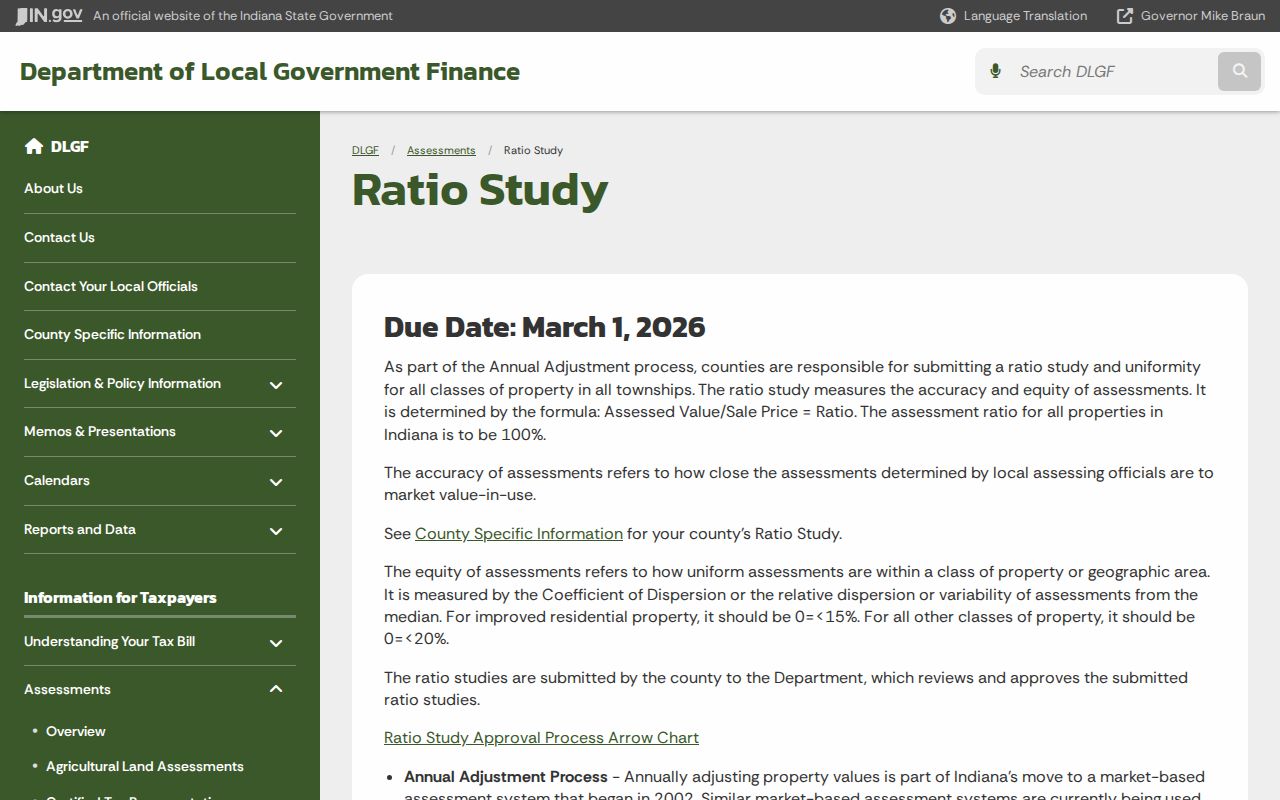
The statewide page supplies the framework. The live county card remains the source for a single parcel's figures. The county Assessor describes the goal as market value-in-use. Similar property and neighborhood groups, property traits, and sales trends all support the estimate. Still, the term belongs to the assessment system. It does not turn a PRC into a current purchase offer.
Note: Current Indiana assessment uses the 100 percent framework, not the obsolete historical one-third convention.
Read Vermillion County Land and Improvement Values
A property record card can separate land from improvements while showing acres, class, legal description, and tax calculations. Those lines explain how the total came together. Always compare the same assessment year across Vermillion County parcels, because annual trending can shift figures without any change to the ground.
- Gross assessment
- The land and improvement value before tax-side reductions.
- Taxable assessment
- The base remaining after qualifying deductions or exemptions.
- Market value-in-use
- Indiana's mass-appraisal standard for the property's use.
- Sale consideration
- A transfer amount whose meaning depends on the deed and transaction.
A homestead classification, agricultural use, or vacant-lot status can make nearby parcels poor comparisons in Vermillion County. Match class, setting, and year first.
Locate a Vermillion County Assessed Value
The legacy Auditor property-information system accepts a parcel number, name, district, tax year, or property address. Treat the address as a lead. Then preserve the APN and year from the matching row of Vermillion County property records.
- Search the full situs address with city in the Auditor tax list.
- Confirm the parcel key, owner lead and district before opening the card.
- Read the land, improvement, gross and taxable lines separately.
- Record the assessment and tax year before making a comparison.
- Assessed value
- The official valuation used in the Indiana tax system.
- Assessment ratio
- The relationship between assessed value and qualifying sale prices.
- Reassessment
- A scheduled physical review within the statewide cycle.
- Trending
- An annual adjustment based on earlier sales evidence.
Find Vermillion County Sale Consideration
The value card is not the only place to investigate a Vermillion County transfer. The Recorder's Doxpop index and the recorded deed can supply an instrument type, parties, date, and legal description. They can also offer a consideration clue. The Auditor also handles sales disclosures. Read the amount alongside the instrument type before treating it as a market sale.
A quitclaim, executor, trust, or life-estate transaction may transfer an interest. It may involve no conventional purchase price. For a comparable sale, confirm similar property, a close date, and an arm's-length exchange.
Track Vermillion County Value Cycles
DLGF property-tax terms explain that annual trending draws on prior sales data. The window includes a prior 14-month period. So a Vermillion County assessment can change without a sale or construction on the parcel itself. Trending moves quietly.
Indiana's 2026 to 2030 cyclical reassessment adds another layer. Counties physically review 25 percent of parcels each year in the four-year cycle. Annual adjustments continue throughout. A Form 11 or PRC is the source for a parcel's actual year and figure.
Note: Do not assign an inspection year to a parcel without its notice or a local schedule.
Compare Vermillion County Value Classes
A Clinton lot sits in a named addition. A Cayuga village parcel fills a different district context. A Dana or Helt Township agricultural tract brings its own land and improvement mix. No single countywide appreciation rate fits them. Compare parcels of the same class and assessment year instead. Check acres, improvements, neighborhood group, district, sale circumstances, and whether deductions affect taxable value. Tax calculations and appeals belong in the Vermillion County property tax records guide.
Date Every Vermillion County Property Value Comparison
A useful comparison records more than a total. Save the parcel key, assessment year, tax year, land amount, and improvement amount. Record the property class, acreage, and district too. For a deed, save the recording date, document type, and stated consideration separately. That habit prevents a common error. Comparing a current assessment with an older transfer is risky. Calling the difference appreciation misreads both records. Annual trending, improvements, deductions, a parcel split, or a non-market transfer can explain the gap. The tax portal warns that recently split or combined parcels may need a last-name search. Others may require a call to the Treasurer.
For appeal research, use the subject Form 11 or PRC. Add sales evidence appropriate to the valuation date. The county guidance stresses evidence and market value-in-use. A Vermillion County value lookup alone does not establish an appeal result.
Note: Verify the live parcel card before relying on any saved figure.
Date Vermillion County Property Values
Save the parcel key, assessment year, land amount, improvement amount, class, and district with every Vermillion County value you note. If a deed amount is used, record its date and instrument type too. That discipline keeps annual trending, a parcel split, a deduction, or a non-market transfer from being mistaken for a simple change in sale value.
Interpret Zero Consideration in Vermillion County Records
A zero in the consideration field is not always what it seems. Vermillion County deeds often show zero or nominal consideration. This happens with family transfers, estate conveyances, trust changes, releases, and corrective deeds. The document type and the granting language tell you which is which. Surveys display zero too, since they describe land rather than a sale.
Read the numbers in context. The Auditor card sets the current assessment year. The Vermillion County Recorder record explains the transfer itself. Never swap a zero consideration amount for assessed value. Never take it as proof the parcel had no worth. Party roles and the legal description often matter far more than the dollar field.
Separate Vermillion County Value Evidence
Gathering value evidence is not the same as proving an assessment wrong. Vermillion County's Form 130 separates current assessed value from the value you claim. It also asks for reasons plus support. A strong packet matches the assessment date, the comparable class, and the property characteristics that matter. The Assessor's market-value-in-use method groups similar parcels and draws on sales data. So one neighboring sale helps, but it rarely overrides the mass-appraisal record. Differences in land area, improvements, condition, use, or district can quietly weaken a comparison.
Appeal deadlines and hearings belong to the tax-record process. Keep the PRC, the Form 11, the deed or disclosure, and any comparables with their dates intact. That way each value stands on its own terms.
Know Vermillion County Property Value Limits
Assessments have limits. No Vermillion County assessment can show current interior condition, a buyer's terms, an unrecorded repair need, or the exact price a property would fetch today. A tax bill blends valuation with deductions, caps, credits, and district rates, so the amount due is never a market-value shortcut.
Value vs price. Vermillion County assessed value serves taxation. It is neither a guaranteed sale price nor a professional appraisal of the parcel today.