
Search Vermillion County Property Records
Vermillion County splits its property records by purpose. Each system answers a different question. The legacy Auditor tax list leads with address and parcel. Doxpop leads with party and document. Vermillion County WebGIS leads with the map, and MyCase leads with the case. Only a street address is in hand? The tax list or WebGIS is the right door. A grantor, grantee, or recording date is known instead, so Doxpop comes first. The parcel key and legal description are what connect these systems to each other.
A tax-card owner is a strong lead. The latest deed is the stronger record of a transfer, though. A GIS line helps locate land but settles no boundary. Court and lien checks can surface disputes without ever proving that title is clear.
- Enter a short address and city in the Auditor tax list; the portal warns against filling too many fields.
- Open the card and save the parcel number, deeded-owner wording, tax district, acres, and legal description.
- Search the owner and prior names in Doxpop, then match the land description and recording references.
- Check the Treasurer account and WebGIS map for the same parcel, while keeping tax and map facts distinct.
- Request a copy from the custodian or use local library and State Library holdings when the online trail ends.
Vermillion County Records Custodians
Newport is the county seat. The courthouse there is the practical records center for Vermillion County. The Recorder keeps title instruments, while the Assessor values real property and the Auditor maintains the tax duplicate, transfers, and current plats. The Treasurer handles charges, installments, delinquency, and payment. Call the right room first. Each office answers a different property records question, and a misdirected one costs time.
Vermillion County Recorder
255 S Main St., Room 202
Newport, IN 47966
765-492-5380
Vermillion County Assessor
255 Main St., Room 203
Newport, IN 47966
765-492-5310
Vermillion County Treasurer
255 S Main St., second floor
Newport, IN 47966
765-492-5360
Three Vermillion County Online Cutoffs
The Recorder's official page lists unusually precise online starting points for Vermillion County records. Deeds begin January 2, 1969 at Book 110. Miscellaneous instruments start March 1, 1972 at Book 48. Mortgages pick up July 12, 1988 at Book 126. Pair each date with its book number, because every series opens at a different boundary.
Older material has not vanished beyond Doxpop's online reach. Ask the Recorder for a known book and page, search at the courthouse terminal, or consult the Indiana State Library and the Clinton Public Library. Those channels hold history a web search cannot promise. The source image shows the Vermillion County Recorder page naming the deed custodian and its online route.
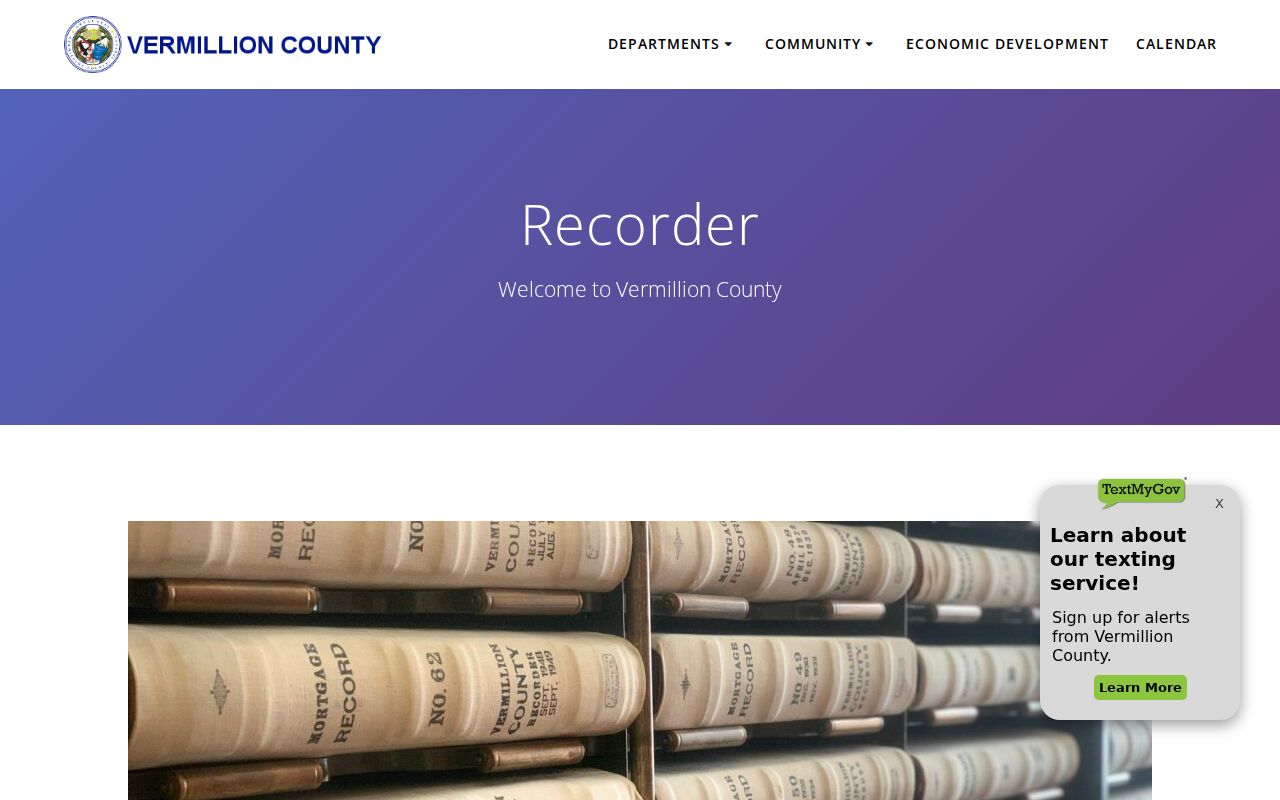
The page is a useful starting point. The recorded instrument held by the office remains the official record for Vermillion County.
Vermillion County Property Record Types
The land trail extends well beyond a deed. Assessment and tax records explain value and charges. Maps show spatial context, plats describe lots, and court files may document foreclosure, partition, quiet title, or lien enforcement. Each source holds one part of a property's public history in Vermillion County.
| Record Type | What It Documents | Kept By | Access |
|---|---|---|---|
| Deeds | Transfers, parties, legal description, references | Recorder | Doxpop, counter, copies |
| Mortgages and liens | Recorded claims, releases, and security interests | Recorder and courts | Doxpop, MyCase, clerk |
| Assessment and tax | Value, deductions, charges, and payments | Assessor, Auditor, Treasurer | Legacy pages, LowTaxInfo, office |
| Plats and parcels | Lot, section, district, and mapped context | Auditor, Surveyor, Recorder | WebGIS, plats, survey files |
| Permits and zoning | Land-use review and approved work | County or municipality | Office files and APRA request |
The question determines the source. Use Vermillion County deed records for the interest conveyed, and the tax system for assessed value or a balance. A plat or survey is the right tool when a legal description, access strip, or lot line matters.
Reading a Vermillion Parcel Card
The county's sample Real Estate Property Information card makes one point clear. Any parcel result deserves a close read. One card can list property class, tax period, a dated deeded-owner history, situs address, parcel key, acres, township, range, section, district, school district, legal description, parties, charges, and tax calculations. Mailing and situs addresses are separate clues. A mailing address is not always the property's location.
One sample card used life-estate wording followed by a named successor, plus older owner entries. That is not a simple current-owner label. Read the deed and any related probate record before describing the legal interest. Another sample called an agricultural parcel "LAND LOCKED". It still supplied an APN, acreage, section, owner history, assessment, and taxes. A parcel trail can be fully valid without an ordinary street address.
- Parcel number
- The local key used to match tax and map records.
- Situs address
- The location assigned to the property, which may differ from the owner's mail address.
- Legal description
- The lot, subdivision, or survey language that identifies the land.
- Deeded owner
- The tax system's ownership field, which still needs deed confirmation.
Vermillion County Map Context
Vermillion County WebGIS offers search, identify, print, layers, parcel tools, and map navigation. It works best after the tax card supplies a parcel number. Roads, nearby tracts, and district overlays then help confirm the correct parcel was found.
Postal city, tax district, and incorporated boundary are three different facts. Clinton, Cayuga, and Dana mailing names can reach beyond municipal limits. The statewide Indiana GIS Data Harvest adds incorporated areas. It also adds school districts and tax districts for comparison. For current parcel identity, county tax and recorded documents remain better. They are the stronger source in Vermillion County.
Vermillion Property Records Offline
Online access is only the first channel for Vermillion County property records. The Recorder accepts counter questions and requests tied to a book, page, party, or document. The county's public-record request form can seek a reasonably particular existing record. It goes to a chosen office. APRA does not require staff to create a custom report. It also does not require them to answer a broad research question.
The Clinton Public Library genealogy collection holds microfilmed probate, marriage, wills, and civil orders. It also has guardianship, newspapers, cemetery records, family books, and other local sources. Requests may arrive by mail, email, web, or phone. The library warns that research can take up to six weeks. The Indiana State Library adds county maps, atlases, and plat books. It also contributes WPA indexes and microfilm finding aids.
Source image: the library's genealogy page describes its local research service for Vermillion County.
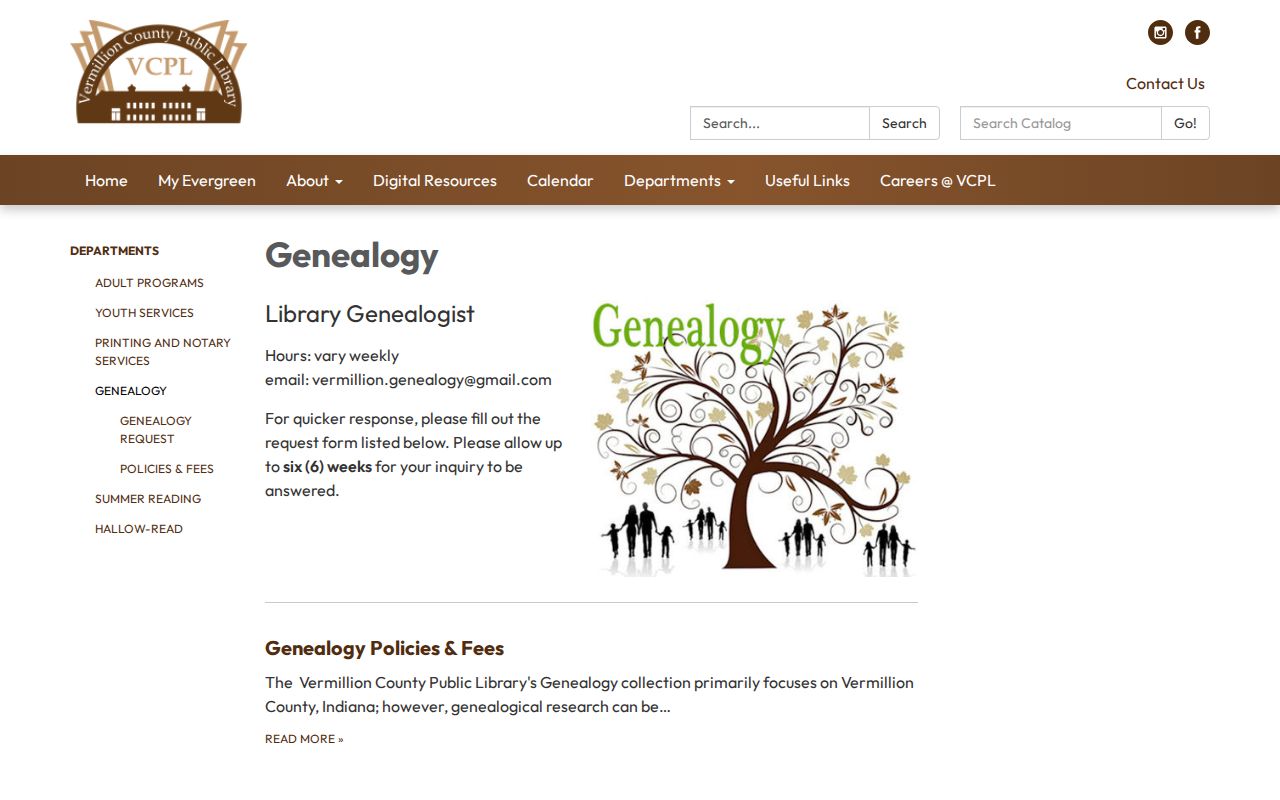
These holdings matter most when an online deed index stops short. Old subdivisions and household histories in Vermillion County often need exactly this kind of context.
A Fire Without Lost Records
Vermillion County split from Parke County in 1824, so its earliest land paper starts there. An 1844 courthouse fire appears in the Indiana State Library's county guide. That guide states plainly that no records were lost. The fire, in other words, did not wipe out the early deed trail. A burned courthouse does not always mean burned records.
What survives is simply scattered. The State Library's microfilm aid notes gaps in some probate volumes. The deed books, plats, maps, court papers, and local histories sit in separate collections. Searching Vermillion County property records well means naming the record series. Then check its actual run. Blaming every missing page on the fire is the lazy conclusion.
Vermillion County Tax and Court Clues
The Treasurer's pages list current charges, warnings, judgments, and tax-sale routes for Vermillion County parcels. Treat them as status clues. A tax-sale advertisement can name the owner. It can also list the mailing address, parcel, amount owed, redemption percentage, and key dates. It still is not proof that title changed hands. Only the deed and later records show what actually occurred.
MyCase serves as the statewide index for nonconfidential court matters. Under the local rule, Vermillion Circuit Court is the county's only court of record. Foreclosure, quiet title, partition, mechanic's-lien, probate, and tax cases can all add context. Each one may sharpen a property search. Online documents exist for only some cases. For public files and older material, the Circuit Court Clerk remains the fallback.
Watch New Vermillion County Deeds
Doxpop Property Watch lets an owner track a name and property descriptions. It covers newly indexed deeds and mortgages. The county recommends adding spelling variants. Indexed names do not always match. Early notice of a filing is the whole benefit here. Monitoring neither blocks nor invalidates an instrument. The county's Fraud Watch instructions explain how to enroll and sharpen the watch terms.
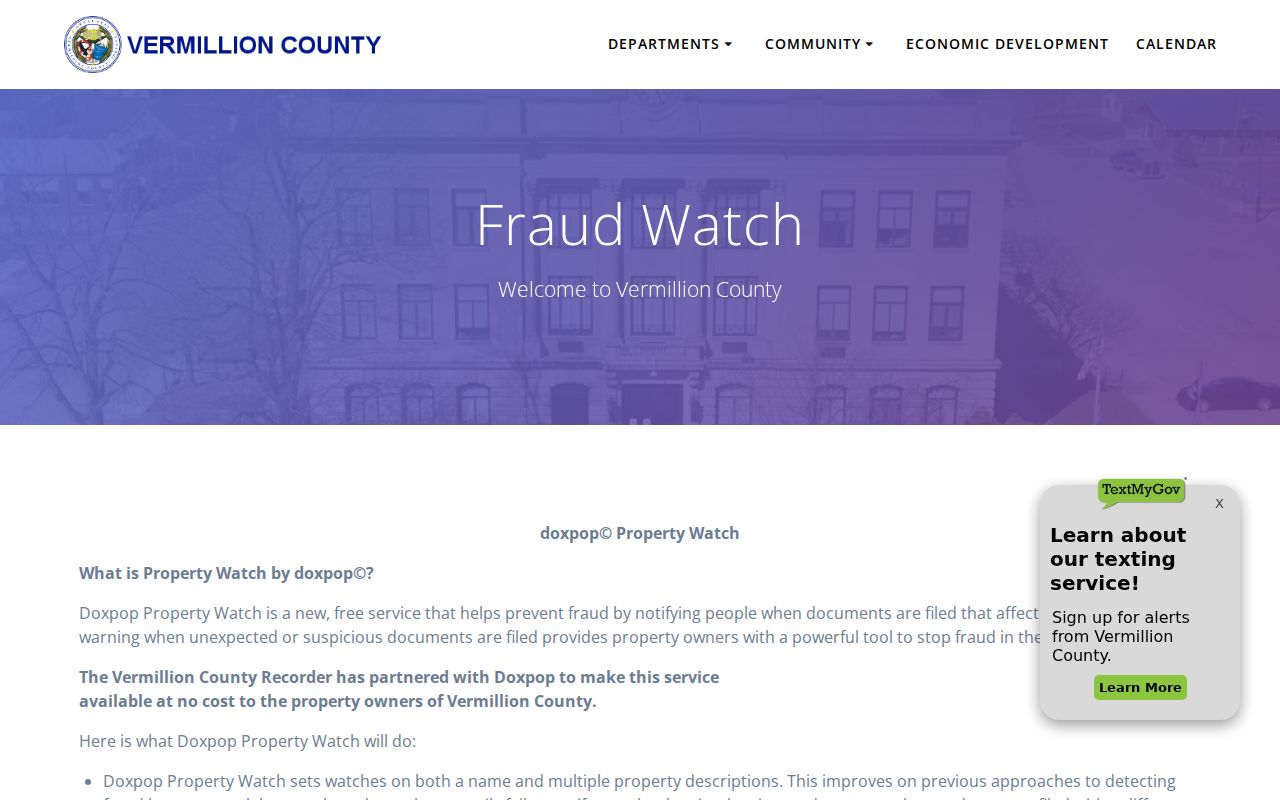
A suspicious alert deserves a direct check with the Recorder. The office's copy fee sits far below the price quoted in the deed-copy solicitation letters it warns about.
Limits of Vermillion County Property Records
Vermillion County property records answer certain questions well. They show who is named, what was assessed, which instrument was recorded, and how a parcel is mapped. They cannot prove occupancy, explain every private right, guarantee a boundary, or replace a professional title examination. Records can also lag a closing. They may carry an old mailing address. Some files reflect a split parcel under a former key.
Lawful use. Vermillion County property records support due diligence, boundary research, estate work, and civic review. They must never be used to stalk, threaten, or harass another person.
Dates Across Vermillion Property Records
Every county system keeps its own clock. A deed carries a document date and a recording date. An assessment ties to January 1. A tax year may be payable the following year. The warning list, judgment list, and main parcel list can each update on different dates. Preserve the label beside every date and amount.
That habit pays off. It stops a tax-roll history entry from being described as a recorded sale. It also keeps an older portal snapshot from passing as the newest status.
No guaranteed timeline connects closing, Recorder indexing, Auditor transfer, and tax-roll refresh. A newly filed deed may appear before the card changes. Recent splits and combinations create the same puzzle. A predecessor parcel key can stop returning the expected tract. Search by last name, find the successor parcel, and compare the legal descriptions.
Each public record also has a defined scope. The Recorder's instrument supplies conveyance terms. The tax record supplies assessment and charge fields. WebGIS adds mapped context, and MyCase adds a public court index. Combining them is genuinely useful. The blend is not a title report, survey, or appraisal.
Vermillion Plats Across Two Centuries
The Indiana State Library's Vermillion County map collection reaches back further than WebGIS ever can. Its inventory holds an 1872 county map naming owners. It also holds the 1909 Standard Atlas on AGLL microfilm Reel 14 with an Indiana Memory route. There is a 1968 farm atlas and resident directory. A 2023 county plat book rounds out the set. Together they can tie an old family name or road to a modern parcel search. They work just as well for a township or farm tract. None of them proves a transfer. An owner label on a historical map is only a lead. It must be tested against the deed books for the same land.
Start with the current parcel's section, township, range, subdivision, and lot clues. Locate that same geography on the nearest historical map. Note the printed owner or resident name. Then search that name in the Recorder's grantor-grantee material. A plat can also reveal a recorded addition name. It may differ from the neighborhood name people use today. For a live boundary question, some records carry far more weight than a traced line on an old atlas. The Surveyor's corner record book is one. A recorded plat is another. So is a licensed survey.
The Auditor prepares current plats by township. The Recorder keeps subdivision plats and recorded surveys. A narrowly framed APRA request can ask for an existing township plat. It can also ask for a parcel-change record for a defined year. APRA does not oblige county staff to build a custom overlay or reconcile two maps for the requester.
Vermillion Assessment Records in Motion
Property records change on different schedules. The Assessor values real and personal property as of January 1 and uses mass appraisal under Indiana's market-value-in-use standard. A Form 11 notice is sent when value changes. The Auditor then prepares the tax duplicate and handles sales disclosures, transfers, current plats, and deduction work. The Treasurer's side shows installments, balances, payments, warnings, judgments, and tax-sale information. A change in assessment does not cause an equal change in the bill because deductions, caps, rates, and taxing districts also affect the result.
Indiana's 2026 through 2030 cyclical reassessment adds a timely layer. The statewide plan calls for physical inspection of about one fourth of parcels per year, beginning the 2026 group in May and completing the cycle by January 1, 2030. Annual trending continues during the cycle. When two Vermillion County property records show different figures, compare the assessment date, tax year, payable year, deduction status, and portal update date before treating the difference as an error.
Owners who disagree with an assessment use Form 130 and the local Property Tax Assessment Board of Appeals process. County guidance identifies a June 15 deadline or 45 days from the applicable notice, depending on what triggered the appeal. Comparable sales, photos, repair estimates, and specific record errors can support the claim. The appeal disputes value, not a tax rate, title interest, or private estimate of an expected sale price.